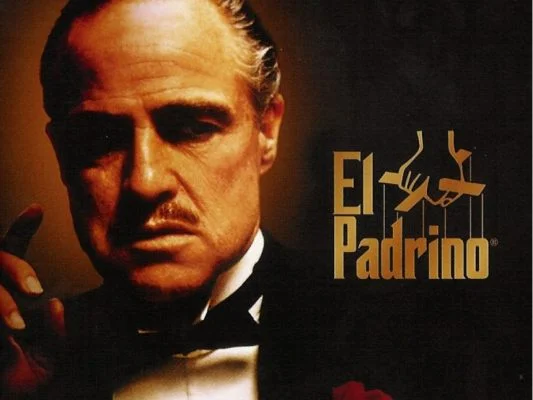
“I’m going to make him an offer he can’t refuse.”
The Book’s Plot
Vito Corleone is the most respected Don in New York, a city he arrived in as an immigrant from his native Sicily at the age of twelve. Don Corleone is implacable with his rivals, but he is also an intelligent, astute man, faithful to the principles of honor and friendship. The life and business of Don Corleone, as well as those of his son and heir, form the axis of this masterpiece. The publication of The Godfather in 1969 caused a convulsion in the literary world, as for the first time, the Mafia appeared novelized from within—presented as its own society with its own culture, and commonly accepted interrelationships and hierarchies. Later, Puzo himself would write the screenplays for Francis Ford Coppola’s famous film trilogy.
Mario Puzo’s book remained on the New York Times Best Seller list for 67 weeks and sold 9 million copies in two years. Although the novel was successful at the time of its release, Puzo disliked it; he said he only wrote it for the money. Published in 1969, it became the best-selling work for several years.
The Godfather Film
Released in 1972, this film presents a precise and profound portrait of an era and an environment, but above all, it is a surreptitious critique of American society, family relationships, political practice, and its moral schemes. These are subtly treated as the background of the script through matters relating to the world of the mafia, immigration, relationships, family systems of dominance, criminal violence, and its political associations.
Part of the work’s visual and stylistic appeal lies in the interpretation of the figure of Michael Corleone. In the film’s opening sequence, Michael is presented to us as a young man distant from the family business; Coppola even uses special filters that reduce his wrinkles, which, combined with lighting and makeup, show us a much younger Michael, newly emerged from adolescence. The brutal change that takes place within him when he assumes the Corleone blood heritage is also reflected in his face; in the final scene, it is that of a mature, complex man who looks directly into the eyes and lies with all his heart.
However, the director has been criticized for offering too attractive an image of the mafia world. The truth is that mobsters were delighted with the businesslike, honorable, and legendary image offered of an “occupation” that was actually murderous and vulgar.
Legendary Quotes
- “I’m going to make him an offer he can’t refuse.”
- “Keep your friends close, but your enemies closer.”
- “Mr. Corleone is a man who insists on hearing bad news immediately.”
- “Mr. Corleone never asks a second favor once he has refused the first.”
- “Is that clear? It’s not personal, Tom, it’s strictly business.”
- “In Sicily, women are more dangerous than shotguns.”
- “I spent my whole life trying not to be careless. Women and children can afford to be careless, but not men.”
- “Never hate your enemies; it affects your judgment.”
Director Francis Ford Coppola
Francis Ford Coppola was born in Detroit in 1939—a very cinematic year to be born.
He is the winner of five Oscars:
- 3 as Screenwriter: Patton, The Godfather Part II, and The Godfather Part III.
- 2 as Director: The Godfather Part II and The Godfather Part III.
Paramount’s original idea was to make a low-budget film of $2.5 million set in the 1970s. At first, they didn’t think Mafia movies would interest the public, so they didn’t want to invest too much. For this reason, they bought the rights from Mario Puzo for the derisory amount of $12,500, with an option for $80,000 if the finished script was made into a movie. Puzo accepted due to his many outstanding debts. As the book became successful, they began to increase the budget until it reached the final $6 million, obtaining total profits of $245 million.
It became the highest-grossing film ever made and was one of the most popular in 1972.
Paramount producers realized that all films made up to that point had been directed by Americans with Jewish roots, never by Italians. Robert Evans decided that it had to be directed by an Italian-American. It was first proposed to Sergio Leone with a first script by Mario Puzo; then it fell into the hands of Ford Coppola, who also had various debts—one of $300,000 with Warner Bros. and another contracted with Roger Corman. Finally, Coppola accepted and rewrote the script together with Mario Puzo, setting it in 1946.
Other Film Curiosities
- The cat being petted by Don Vito Corleone was a stray that wandered onto the set, so Marlon Brando improvised.
- Frank Sinatra was compared to the character Johnny Fontane, a musician who in the film is under the protection of “The Family.” Mario Puzo always flatly denied this.
- In reference to the great work done by Mario Puzo in scripting his book, the authorship of his work is named in the first credits: Mario Puzo’s The Godfather.
- The shoot lasted 62 days, with a budget of $6 million, receiving 11 Oscar nominations and winning 3.
- Sylvester Stallone auditioned for several roles.
Film Technical Sheet
Director of Photography: Gordon Willis, nicknamed “The Prince of Darkness.” The film is so dark because he wanted to show the world as somber and murky as the one they moved in.
There was great conflict between Willis and Coppola. Gordon Willis placed lighting on the sets and characters with millimetric precision, while Coppola needed space for the actors to move. It was a clash of titans until they finally understood the great work they were doing individually and realized what they could achieve working together.
Music: Nino Rota, creator of the soundtrack. The music has its own prominence and helps drive the action of the film.
Casting: Robert Evans preferred certain actors (Robert Redford, Warren Beatty, and even Jack Nicholson for the role of Michael, or Alain Delon) in contrast to Coppola’s opinion.
Coppola wanted Marlon Brando to play Vito Corleone from the start, but Paramount refused because Brando’s performance in Mutiny on the Bounty had caused major problems. During the audition for Don Vito Corleone, Marlon Brando had the brilliant idea of putting several napkins in his mouth, creating and shaping the character; this is how he convinced the producer.
The main actors didn’t earn much money: Al Pacino was paid $30,000, and Marlon Brando $50,000 plus a 2% profit at the box office ($100,000 for Francis Ford Coppola plus a 6% profit).
Some of the Characters
- Marlon Brando: Vito Corleone
- Al Pacino: Michael (Mike to the family)
- James Caan: Sonny
- Robert Duvall: Tom Hagen (the orphan found on the street and Vito’s godson)
- Diane Keaton: Kay Adams (Michael’s wife)
- John Cazale: Fredo
- Talia Shire: Connie (Vito Corleone’s only daughter; she is actually Francis Ford Coppola’s sister)
All the extras in the film were personally chosen by Coppola to have the faces of real Italians. (Special mention is made because, when playing Spaniards, they usually select Mexican, Puerto Rican, or Cuban actors, but not usually Spaniards).
Other Curiosities
Since its release, the film has been widely considered one of the best and most influential films in history, especially in the gangster genre. It was selected for preservation in the US by the National Film Registry of the Library of Congress in 1990, being considered “culturally, historically, or aesthetically significant,” and is ranked as the second-best film in American cinema (behind Citizen Kane) by the American Film Institute.
It is the first of a film trilogy, followed by its sequels The Godfather Part II (1974) and The Godfather Part III (1990).