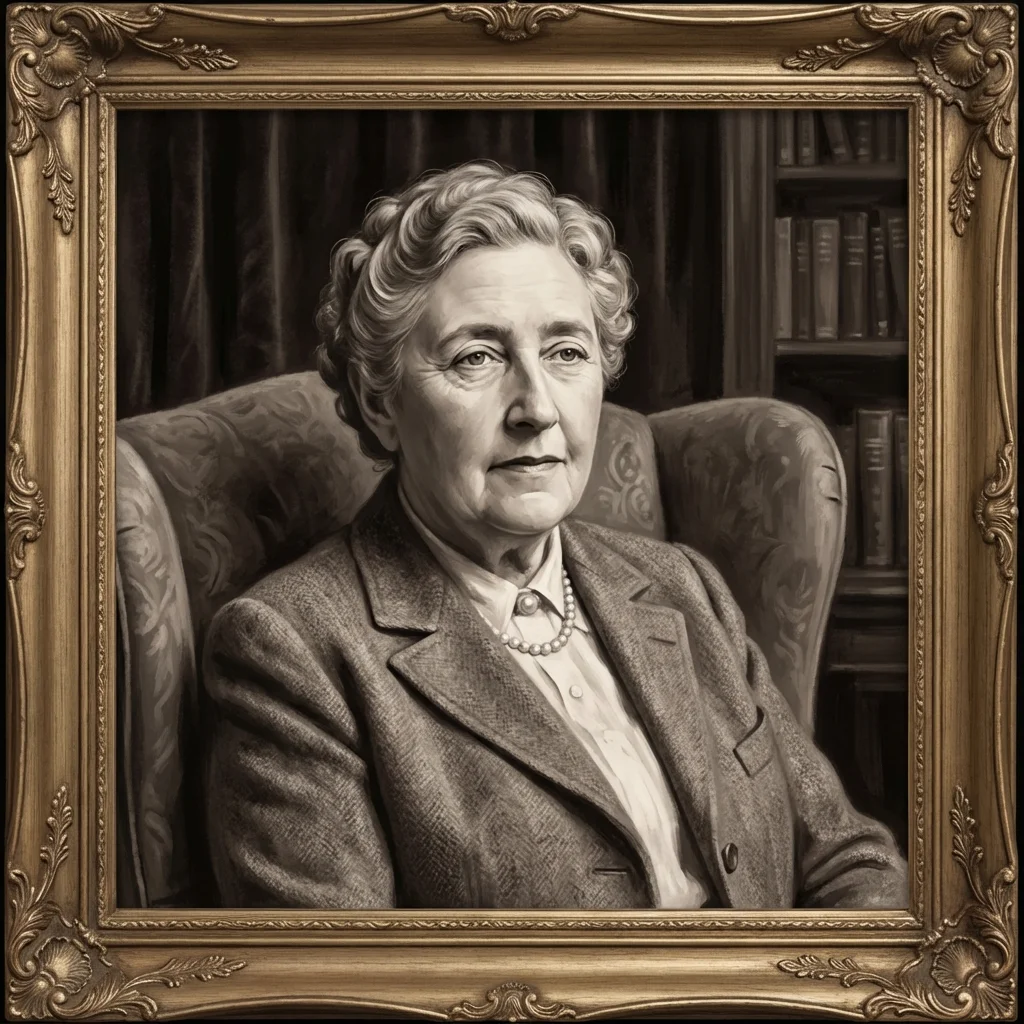
» The impossible could not have happened; therefore, the impossible must be possible, despite appearances. « .
Biography.
Her parents: Clara Boehmer, her mother, and Frederick Alvah Miller, her father.
Both insisted that their daughter receive a home education, taking it upon themselves to teach her to read, write, and master basic arithmetic. Though her mother firmly believed children should not learn to read until the age of eight, Agatha taught herself at the tender age of four. She was also instructed in music, learning to play an array of instruments, including the guitar and the mandolin.
She harbored a profound fascination for Sherlock Holmes, and her mother would read her sweeping gothic and detective tales. She possessed a remarkable aptitude for mathematics, which goes a long way toward explaining her gravitation toward crime literature—a genre that is, in essence, a complex web of puzzles waiting to be solved through scattered clues.
On the southern coast of Devon, Agatha’s presence remains ubiquitous, for it was there she enjoyed an idyllic childhood at the close of the 19th century. Agatha Mary Clarissa Miller was born on September 15, 1890, the third child of Mary Clarissa Miller (the daughter of a military man) and Alvah Miller.
She adored trees and spent hours playing in the garden, raised in a reasonably affluent household. She never attended a formal school, receiving her primary education at home; perhaps it was this unconventional upbringing that nurtured her uniquely analytical mind. Coming of age, she began attending dances and galas, relishing the sensation of roller-skating along the pier. Like many young ladies of her era, she traveled to Paris to study music and French, though she eventually conceded that her musical talents would never quite be sufficient.
Her mother formally presented her as a debutante in high society, far away in Egypt. She was a woman of undeniable courage and ample free time, driven by a profound wanderlust; in 1911, she boarded an airplane for the very first time.
Her Early Literary Period.
Agatha met her future husband, Archibald Christie, at a dance. He was among the first gentlemen to serve in the Royal Flying Corps. Eager to marry her at the outbreak of the war, they seized the moment when he was granted a special Christmas leave, finally deciding to tie the knot.
Archie returned to the grueling theatre of war, and she began working in the first public wartime hospital—initially as a nurse, and later transferring to the dispensary. During the conflict, the hospital effectively transformed into a massive pharmacy, and she resolved to master the trade. It was within those walls that her very first mysterious case was born: « The Mysterious Affair at Styles ». For the first time, she presented her readers with a murder where poison was the lethal weapon (knowledge directly gleaned from her tireless hours in the hospital dispensary). It marked the first mention of strychnine, a merciless toxin that tortures its victims by violently contracting every muscle until death ensues. On occasion, she would even return to the hospital in the dead of night, entirely driven by the need to ensure she hadn’t made a single error in her careful calculations.
She completed the novel before the war concluded, yet six different publishers promptly rejected her manuscript.
When the war finally ended, she and her husband relocated to London, where her only daughter, Rosalind, was born in 1919. In 1921, The Bodley Head publishing house agreed to release her first novel, and that very same year, Archie was offered an opportunity to travel the globe to promote the British Empire. In 1922, as she penned her second novel, « The Secret Adversary», the couple embarked on a grand adventure meant to showcase the vast splendor of the Colonial Empire, traveling from England to the Canary Islands, New York, the Fiji Islands, and Honolulu. These voyages served as endless fonts of inspiration for her writing. It was in the surf of Honolulu that she even learned to ride the waves on a surfboard.
She wrote 66 novels, and in the vast majority of them, she intricately wove the exotic locales she had personally traversed.
A thoroughly modern woman for her era, she held a driver’s license and harbored a deep passion for driving.
In 1926, her beloved mother died of bronchitis. Shortly thereafter, the agonizing realization struck: her husband was having an affair with Nancy Neele, using golf as his threadbare alibi. On December 3 of that fateful year, Agatha’s car was discovered abandoned and empty. Some claimed she had suffered a temporary loss of consciousness. In truth, she was the mastermind of a meticulously crafted plan: Archie had to pay. Agatha abandoned her car exactly where her husband used to carry on his affair with Nancy, leaving behind a tantalizing enigma… How did she manage to travel from there to the Swan Hydropathic Hotel in Harrogate, and why on earth had she registered under the name of her husband’s mistress (Nancy)? Thirteen days later, a member of the local brass band recognized her, plunging the entire nation into an uproar. Her disappearance had triggered such a profound shock across England that even the Royal Family commanded Scotland Yard to make finding her their absolute priority.
Tellingly, in her sweeping autobiography, she never once mentions the incident.
Her Second Literary Period.
In 1928, the couple divorced, and her novel «** The Mystery of the Blue Train** »—written during a retreat in the Canary Islands—was published. Though she confessed she was never particularly proud of that specific book, the years between 1928 and 1930 proved to be an incredibly prolific period for her work.
Shortly after the divorce, she embarked on a solitary journey, boarding the legendary Orient Express bound for Syria and Iraq. It was there she crossed paths with Max Mallowan.
She had initially intended to visit Jamaica. However, while attending a dinner party, she overheard breathless tales of Mesopotamia and completely altered her travel plans. This was a genuinely extraordinary undertaking, as women rarely travelled alone in those days. Stepping onto the train at Victoria Station, she settled into her compartment and savored the opulent rhythm of the Orient Express. Greeted upon her arrival in Istanbul, she continued onward to Baghdad.
In 1928, Baghdad lay heavily under British dominion, but she yearned to witness the authentic customs of the land. She journeyed to Ur to delve into the fascinating world of archaeology, falling hopelessly in love with the atmosphere—the meticulous, painstaking extraction of ancient relics, the tireless laborers, and the breathtaking colors that washed over the desert at dawn and dusk.
In 1930, she returned to Ur. Her friends, the directors of the excavation—Leonard and Katharine Woolley—asked their young archaeologist friend, Max Mallowan, to accompany her on an excursion. A quiet friendship began to bloom between them, culminating on an exhausting day when they found themselves stranded in the desert for hours, waiting on a broken-down car. It was in that desolate, sun-baked landscape… that Max abruptly realized she was his perfect match.
Agatha had to depart entirely too quickly because her young daughter fell ill. Max resolved to escort her, proposing marriage several times over the ensuing months. She gently rejected him due to their fourteen-year age gap, until, ultimately, she surrendered and accepted. At the time, she was 40, and Max merely 26—a scandalous fact that drew countless whispering tongues. On a document he procured to allow him to work in Syria, Agatha’s age was quietly altered so she would not appear elderly, thereby defending the ‘honor’ of her adoring husband.
They married in 1930. She quietly helped finance her husband’s academic career, often choosing to remain entirely anonymous in her generous patronage. Once wed, they spent long, grueling periods in the East—ranging from three to six months at a time. Agatha seamlessly integrated into her husband’s excavation team, inventing novel methods to carefully extract fragile artifacts. She played a pivotal role in forging bonds with the locals in the various regions they excavated. Furthermore, she meticulously photographed the priceless pieces and the surrounding landscapes, producing an exquisite body of documentary work (having attended a highly progressive school of photography to hone her craft).
In 1933, Agatha and Max brought Rosalind along with them on a journey down the Nile, where she penned her masterful « Death on the Nile ». Ironically, she had gradually grown to detest Poirot, yet that book, along with « Murder on the Orient Expres s», would ultimately become two of her greatest triumphs.
The final novel, in which she definitively kills off her famously fastidious Belgian detective, was locked securely in a safe, carrying explicit instructions that it was not to see the light of day until after her own passing.
In 1934, the couple purchased their first marital home, “Winterbrook House,” nestled on the outskirts of the idyllic village of Wallingford in Oxfordshire. She possessed a deep affection for beautiful houses, and in 1938 they acquired the breathtaking Greenway estate on the southern coast of Devon. She yearned to remain close to her family and to the hallowed grounds of her childhood, famously declaring that there were only three other places on earth that could possibly rival the devastating beauty of that beloved retreat.
She published 66 detective novels, 6 romance novels, and 14 short story collections—many under the pseudonym Mary Westmacott —and fearlessly ventured into playwrighting, crafting 30 theatrical pieces, including the immortal « The Mousetrap » and «Witness for the Prosecution».
Her Two Principal Characters.
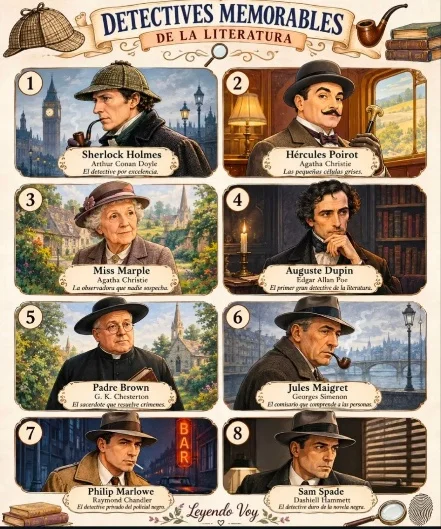
The author’s very first book, « The Mysterious Affair at Styles », was published in 1920 and formally introduced Hercule Poirot to the world. He would go on to feature in 33 of her novels and 54 short stories.
Another of her most beloved creations, Miss Marple, debuted in ** The Thirteen Problems** (also known as The Tuesday Club Murders), a short story from 1927. To breathe life into this iconic spinster, Christie drew profound inspiration from her own grandmother, her grandmother’s circle of friends, and her formidable aunts.
Curiously, she never once allowed her two brilliant protagonists, Poirot and Marple, to cross paths within the pages of a single novel. In a newly rediscovered audio recording released in 2008, the author candidly explained her reasoning: » I am quite sure they would not have enjoyed meeting. Hercule Poirot […] would absolutely detest having someone explain to him exactly how to do things, or having an elderly spinster offer him unsolicited suggestions. «
Murder on the Orient Express, featuring the peerless Belgian detective Hercule Poirot, has been translated into more than 60 languages.
Colonel Race, a dashing Secret Service agent, was introduced alongside the husband-and-wife sleuthing team, the Beresfords, in the 1920s, subsequently appearing in four novels spanning 1924 to 1945. The steadfast Superintendent Battle featured in another five, from 1925 to 1944. Tommy and Tuppence were the beloved centerpieces of four novels and a series of short stories published between 1922 and 1973. In the 1930s, Christie also conjured up Harley Quin and his loyal associate, Mr. Satterthwaite, as well as Parker Pyne and the irrepressible Ariadne Oliver. While Quin, his colleague, and Pyne appeared exclusively in short stories, Oliver found herself entangled in six novels over the course of four decades, often sharing the page with Poirot himself.
She gravitated toward murder and homicide precisely because she so deeply cherished life; she was captivated by the puzzle of the genre, rather than the morbidity of death. She has undeniably influenced the vast majority of crime and mystery writers who followed in her monumental wake.
Agatha’s own cosmopolitan flair is vividly reflected in Poirot, yet her grounded common sense and intimate understanding of her British compatriots flowed directly into Miss Marple (who bears more than a passing resemblance to Agatha herself), though Christie continuously maintained that her Victorian grandmother was the truest inspiration. Strong, independent female characters invariably feature in her novels, perfectly mirroring her own deeply autonomous spirit.
In the realm of theatre, she wrote numerous plays, exceeding 30 in total. However, one occupies a legendary place in history: « The Mousetrap ». Its astounding triumph is due in part to its historical endurance; premiering in 1952, it has relentlessly maintained its continuous run in London to this very day. Its producer brilliantly devised ‘Mousetrap parties’ hosted on the grand cruise liners arriving across the ocean from the United States.
In 1976, she passed away peacefully in her home, and her final Miss Marple novel was subsequently published posthumously.
British Recognition of Her Literary Genius.
In 1950, she was elected a dignified Fellow of the Royal Society of Literature _._ Furthermore, she received the inaugural Grand Master Award bestowed by the Mystery Writers of America exactly half a decade later. She was also appointed a Commander of the Order of the British Empire (CBE) in 1956, just one year before ascending to the presidency of the prestigious Detection Club.
In 1961, she earned an honorary doctorate from the University of Exeter.
Finally, in 1971, Queen Elizabeth II elevated Agatha Christie to Dame Commander of the Order of the British Empire, rendering her the only female writer to have achieved this monumental honor exclusively through the unrelenting brilliance of her pen.
Her Works.
- 66 novels and more than 150 short stories, featuring the following appearances:
- 33 novels and more than 50 short stories: Hercule Poirot (sometimes accompanied by Captain Arthur Hastings)
- 12 novels and more than 20 short stories: Miss Marple
- 4 novels and 17 short stories: Tommy and Tuppence Beresford
- 3 novels: Superintendent Battle
- 14 short stories: Parker Pyne
- 1 novel: Mr. Harley Quin
- 6 romance novels
- 23 stage plays, of which:
- 17 were penned exclusively by her own hand
- 6 were adapted by external playwrights, based upon her beloved novels
- 4 radio dramatizations
- 2 autobiographical volumes
- 3 collections of poems and children’s stories
- 3 co-authored productions with the prestigious Detection Club
Despite exploring the depths of death on paper, she knew masterfully how to truly live.
She chose to write of murder and homicide because she so fervently loved life; she was enthralled by the mechanics of the genre itself, far more than the finality of death. She remains an unparalleled influence upon the tapestry of modern crime fiction.
All information has been sourced and carefully extracted from various printed, digital, and audiovisual archives.
Orient Express.
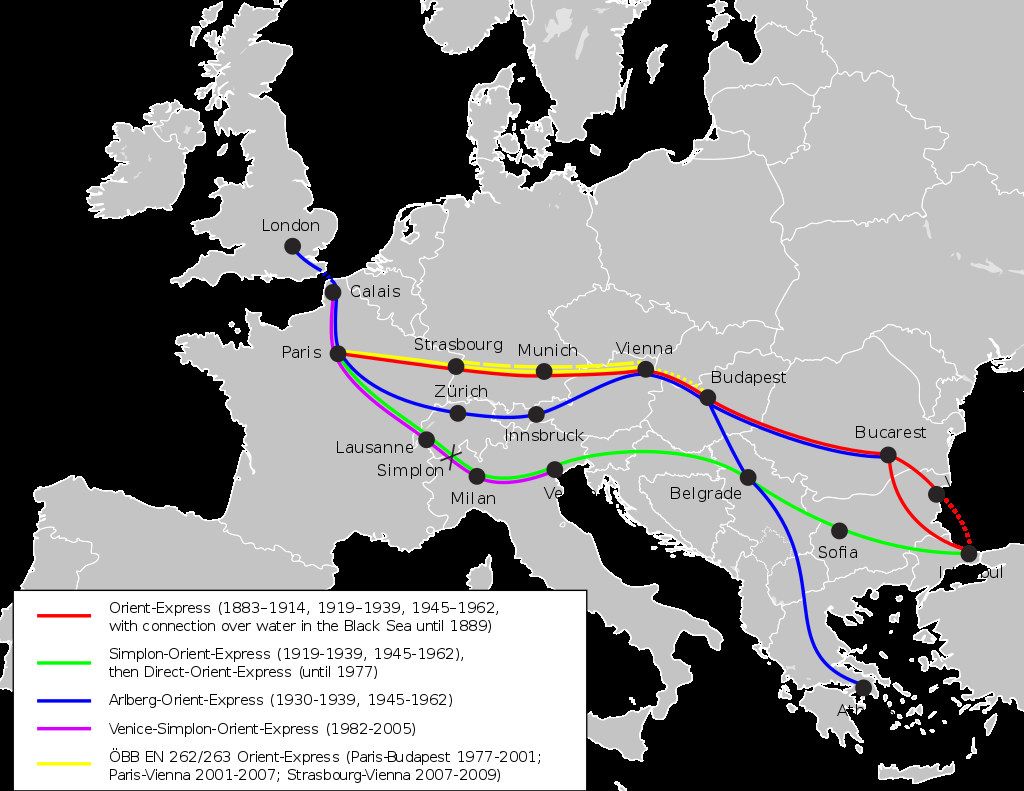
The Orient Express was the evocative title bestowed upon the long-distance passenger train service that, at its absolute zenith, seamlessly linked Paris with Istanbul. From its extravagant inauguration in 1883 until 2009, its route was perpetually altered by the shifting tides of logistics and global politics. It was universally celebrated as one of the most luxurious trains in existence, boasting a manifest that consistently included the world’s most prominent millionaires, diplomats, and glittering members of the European aristocracy.
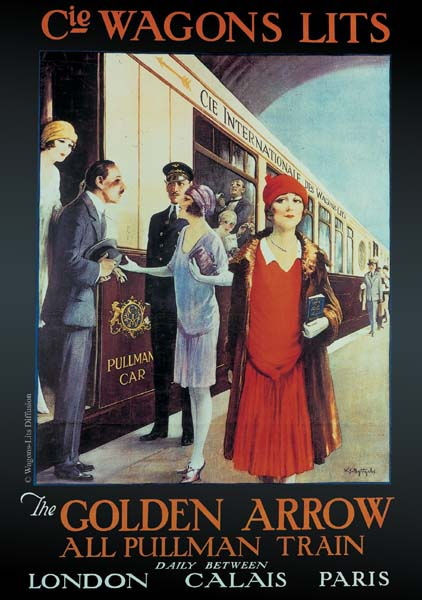
In the 1930s, the Orient Express reached its breathtaking apex, proudly running three distinct services crisscrossing the heart of Europe: the original Orient Express, the Simplon Orient Express, and the newly christened Arlberg Orient Express, which elegantly traced a path from Paris to Budapest via Zurich and Innsbruck, with sumptuously appointed sleeping cars continuing their journey all the way to Bucharest or Athens. During this golden age, London proudly offered seamless connections to the Simplon. Affluent passengers departed on the British Southern Railway from Victoria Station down to Dover, where they gracefully boarded a ferry to Calais. From there, they traveled by train to the sweeping expanse of La Gare de Lyon in Paris, where their carriages were swiftly coupled to the Simplon. It was precisely during this era that the Orient Express truly cemented its legendary reputation as a palace on wheels; offering a peerless first-class service to its discerning passengers (with highly renowned master chefs commanding its kitchens), the manifest boasted royalty, diplomats, industrial tycoons, and internationally acclaimed personalities. From 1930 onward, absolutely no expense was spared: the finest furniture from around the world was meticulously selected, and for the lavish table service and cutlery, the most prestigious brand in the world—a masterclass in luxury design, the esteemed Italian maker Cesa 1882—was exclusively chosen.
Decline and the Withdrawal of Service.
In 1962, both the original, storied route of the Orient Express and the Arlberg Orient Express were unceremoniously withdrawn from circulation, leaving only the Simplon Orient Express to bravely carry the torch. Yet, later that very same year, it was sadly replaced by a noticeably slower service unromantically dubbed the Direct Orient Express. It offered daily departures directly to Belgrade (faithfully following the very same sweeping trajectory of the Simplon), from where trains dutifully continued their journey to Istanbul and Athens merely twice a week.
In 1971, the illustrious Wagon-Lits (CIWL) company made the heart-breaking decision to act solely as a service provider on the trains, formally selling or leasing its magnificent carriages to an array of different European rail companies. In 1976, the long-standing Paris-Athens service was completely and utterly suspended.
In 1977, the once-proud Direct was pulled from active circulation; its final, mournful journey between Paris and Istanbul occurred on the 19th of May of that year.
Despite the pervasive murmurs that the Orient Express had truly reached the end of the line, a portion of its original, historic route was briefly resurrected, bearing the proud original name of Orient Express. Between the years of 1977 and 2005, it gamely departed Paris bound for Budapest, with a scant few, lonely departures reaching Bucharest. During this period, the trains themselves were an amalgamation of French, Austrian, Hungarian, and Romanian carriages, though all were still impeccably serviced by the seasoned staff of the Wagon-Lits.
Since 1996, in a noble effort to aggressively rein in counterfeits and curb the abusive pilfering of its legendary image, the CIWLT (Compagnie Internationale des Wagons-Lits et du Tourisme), now a proud part of the sprawling international ACCOR Group, specifically created Wagons-Lits Diffusion SA. This specialized subsidiary was tasked strictly with passionately managing the brands, the priceless historical archives, and all the attendant historical rights (trademarks and Intellectual Properties). Any prospective use must be formally authorized by Wagons-Lits Diffusion SA, securely based in the heart of Paris, France.[2]
On June 10, 2001, the historic journey was severely limited, shrinking to merely the Paris-Vienna route. Finally, at the bitter end of 2009, the Orient Express undertook its last, solitary journey. This final withdrawal was firmly motivated, according to the weary company, by the unstoppable rise of cheap budget airlines and the relentless expansion of high-speed rail networks.