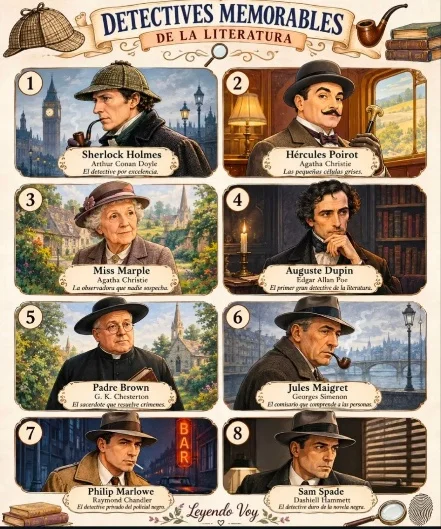
“I have my eye on a suite in Baker Street,” he said, “which would suit us down to the ground. You don’t mind the smell of strong tobacco, I hope?” Sherlock Holmes.
Created by Sir Arthur Conan Doyle, the peerless consulting detective Sherlock Holmes and his intrepid companion Dr. John Watson made their debut in A Study in Scarlet, published in 1887 within the pages of Beeton’s Christmas Annual. Although the final canonical adventure of Holmes and Watson saw the light of day in 1927, Sherlock Holmes remains a towering international cultural icon. In truth, he may be more popular today than ever before. The zeitgeist is thoroughly saturated with all things Holmesian: two Hollywood blockbuster films; a recent BBC television series; an upcoming American television adaptation; and countless other television shows, stage plays, and films that have drawn inspiration from the adventures of Holmes and Watson. Indeed, one could argue that the entire “buddy-cop” genre traces its lineage back to Arthur Conan Doyle’s legendary detective duo.
Let us begin by stalking through the gas-lit streets of Victorian London, turning our magnifying glass toward an architectural enigma defined by Holmes and Watson—a mystery in and of itself: their London flat at 221B Baker Street.
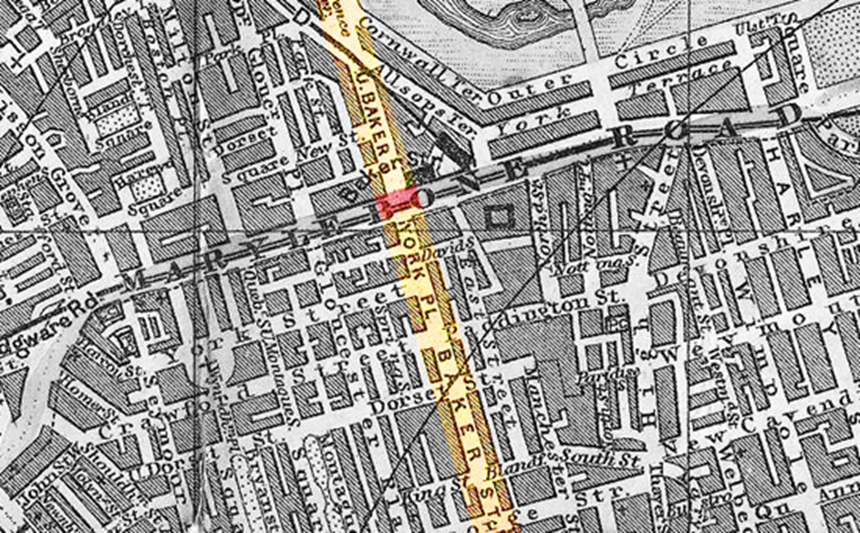
The mystery of 221B Baker Street is not one of secret passageways or occult symbols. Rather, it might be described as an existential spatial riddle: how can a space that is not a space be situated where it is not? According to the tales of Arthur Conan Doyle, Sherlock Holmes and John Watson resided at 221B Baker Street from 1881 until 1904. Yet, 221B Baker Street did not exist in 1881, nor did it exist in 1887 when A Study in Scarlet was published, as house numbers on Baker Street extended only into the 100s at that time. It was an entirely fictitious address—the emphasis being on the word was. As time marches forward, Baker Street is renumbered, and 221B reveals itself.
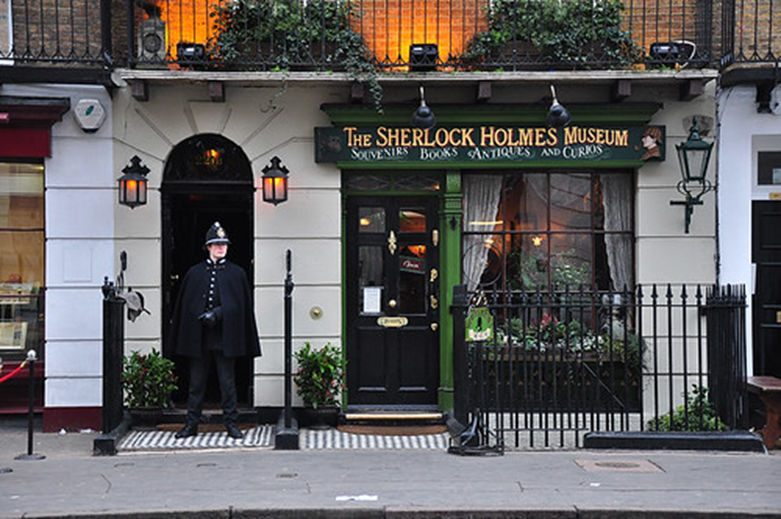
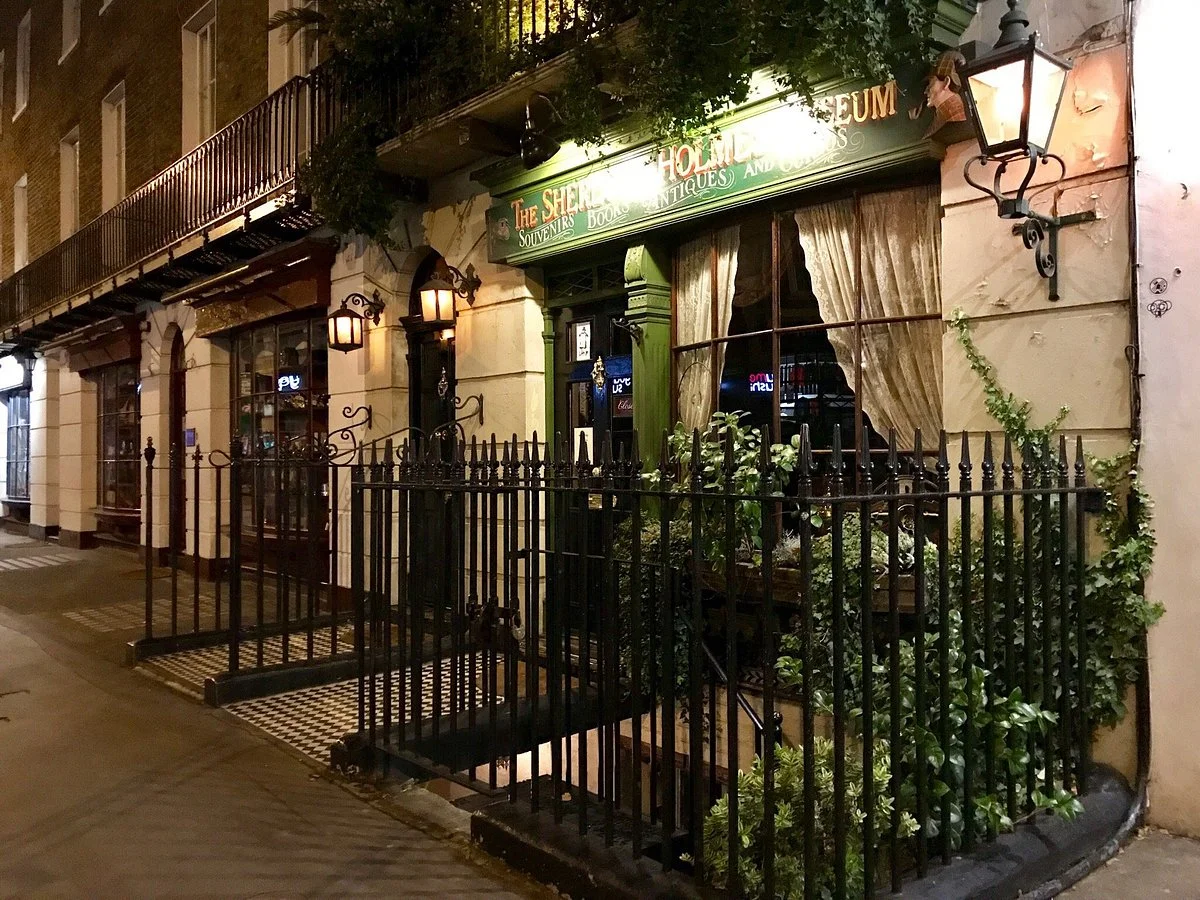
Should you visit 221B Baker Street today, you will encounter the Sherlock Holmes Museum, inaugurated in 1990 by the Sherlock Holmes International Society. But, technically speaking, the Sherlock Holmes Museum is not located at 221 Baker Street. In fact, there is still no genuine 221 Baker Street. Since the 1930s, the renowned address has been subsumed within a larger block of buildings originally occupied by the Abbey National Building Society. From almost the very day the Abbey National opened its doors, it began receiving letters from all corners of the globe addressed to Mr. Sherlock Holmes at 221B Baker Street. The deluge of correspondence was so vast that the bank’s public relations department found it necessary to hire a full-time secretary tasked exclusively with answering the urgent inquiries of those desperately seeking Holmes’s unique deductive prowess (these pleas were generally met with the polite response that the detective had retired to keep bees in Sussex).
When the Sherlock Holmes Museum opened its doors at 239 Baker Street—in a Georgian townhouse remarkably similar to Conan Doyle’s imagined 221 Baker Street—a controversy swiftly arose over which establishment rightfully deserved to receive the letters.
By poring over the texts, scholars have proposed multiple Baker Street addresses as potential inspirations for the literary 221; nevertheless, a definitive answer remains elusive.
It first appeared in “A Study in Scarlet” when, faced with financial hardship, Watson resolves to seek a flatmate to share expenses. Thus, through the mediation of an old mutual acquaintance (Stamford), the doctor and the detective meet for the first time.
» Sherlock Holmes seemed delighted at the idea of sharing his rooms with me.
— “I have my eye on a suite in Baker Street,” he said, “which would suit us down to the ground. You don’t mind the smell of strong tobacco, I hope?”
— “I always smoke ‘ship’s’ myself,” I answered.
- A Study in Scarlet** 🖋️**
Watson once remarked that the monthly rent Holmes paid was nearly equivalent to the total value of the house. This goes a long way in explaining why Mrs. Hudson, their long-suffering landlady, tolerated the numerous (and extravagant) eccentricities of our investigator.****«
The rooms themselves receive scant attention beyond the assurance that they perfectly suited the needs of Messrs. Holmes and Watson, consisting of "a couple of comfortable bed-rooms and a single large airy sitting-room, cheerfully furnished, and illuminated by two broad windows." Similar brief descriptions are scattered throughout the Holmes canon, usually a mere handful of words. Yet, from these meager clues, dedicated collectors worldwide have been inspired to meticulously reconstruct their own versions of 221B.
» In a moment of respite, Watson rose from his writing desk—rescued many years prior from Mrs. Hudson’s attic in Baker Street—and moved toward the small library they maintained in the sitting room of their current residence.****«
- His Last Bow** 🖋️**
» That very night, a thoroughly dismal one, Holmes and Watson found themselves smoking their pipes quietly before the hearth, lulled by the soothing drumming of the rain against the windowpanes of their chambers. Startled, both men abruptly sat upright, believing they heard the metallic clatter of the typewriter in the hallway. They shared the same thought: the Remington 2 had sprung to life, the intermittent sound of the rain having masked its dutiful, rhythmic operation until that moment.****«
- The Case of Henry Staunton** 🖋️**
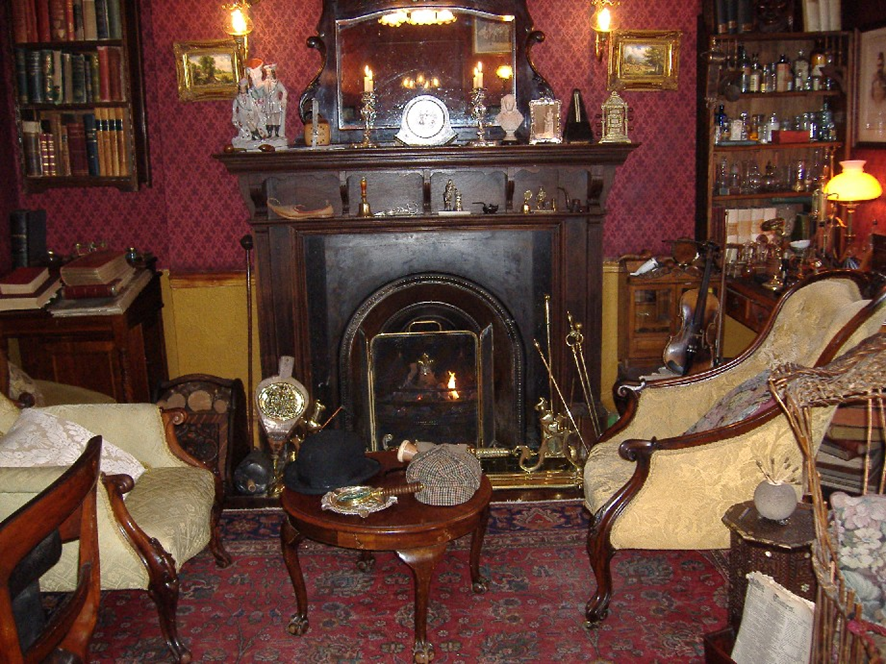
The Sherlock Holmes Museum in London.
Perhaps the most frequented replica of 221B is the aforementioned recreation at the Sherlock Holmes Museum on Baker Street, which pledges to visitors that "the interior has been maintained faithfully for posterity exactly as described in the published stories." The Museum’s flat may also be the most comprehensive of the numerous 221Bs, as it includes Watson’s second-floor bedroom, whereas the majority of reconstructions concentrate exclusively on Holmes’s sitting room.
In this sitting room, visitors will discover the original wicker chair depicted by the celebrated Holmes illustrator, Sidney Paget, in his iconic portrait of the seated detective. In a certain sense, one might argue this chair truly is Holmes’s chair. However, while the flat boasts many recognizable Holmesian artifacts and ephemera, certain inferences must inevitably be made to flesh out the fictional Victorian setting. Such a replica is, in essence, an architecture of deduction—a physical manifestation of Sherlock Holmes’s signature art form. Yet, unlike Holmes’s brilliant deductions, the answer here is never absolutely certain. The pipe and magnifying glass, the scattered newspapers, books, and test tubes: these items serve as an index to the life of Sherlock Holmes. But the choice of wallpaper, the selection of period furniture, the specific titles on Holmes’s bookshelves—these are pure extrapolations reflecting the collector’s own taste, style, and opinions. Indeed, when it comes to the mystery of 221B Baker Street, there are as many deductions as there are detectives.
"Old Scotland Yard is just across Northumberland Avenue, and the Turkish baths that Holmes and Watson so frequently enjoyed were right next door to the hotel. In fact, one can still see the entrance, now integrated into the bank’s wall in Craven Passage. With Charing Cross Station immediately adjacent to the pub, one can easily picture the duo sprinting to catch a train to the countryside on one of their hair-raising adventures!"
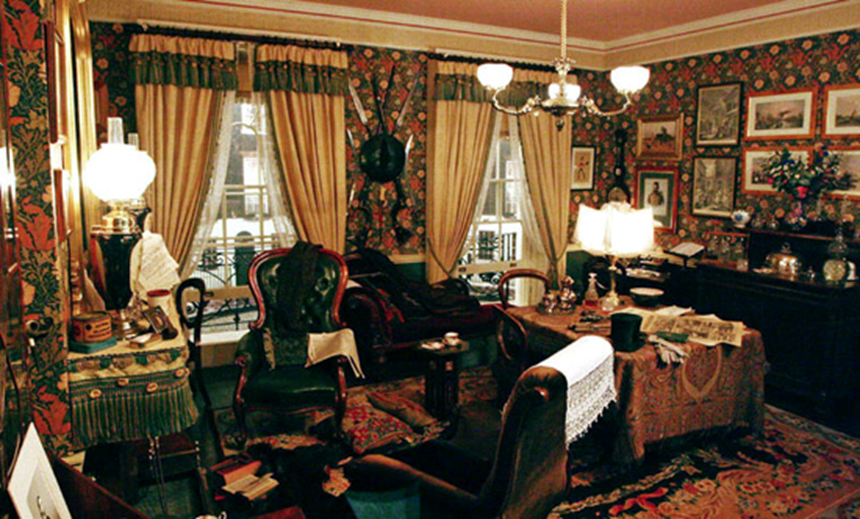
House Museum in Meiringen, Switzerland.
Just as the adventures of Holmes and Watson often whisked them away from London to exotic locales across the globe, the same proves true for their surprisingly nomadic flat. Another replica of 221B Baker Street rests in the Sherlock Holmes Museum in Meiringen, Switzerland—near the Reichenbach Falls, the very site of the climactic final battle between Holmes and his arch-nemesis, Professor Moriarty. The Meiringen Museum claims to house the largest collection of Holmes ephemera, alongside the most painstakingly accurate reproduction of the famous sitting room, meticulously reconstructed by Tony Howlett (former president of the Sherlock Holmes Society of London) and architect John Reid. Its windows are authentic to the era, crafted in London and shipped to Switzerland; the wallpaper is designed after an authentic 1890s pattern purchased on the High Street in London; the fireplace, oil lamps, and other Holmesian paraphernalia are genuine Victorian antiques.
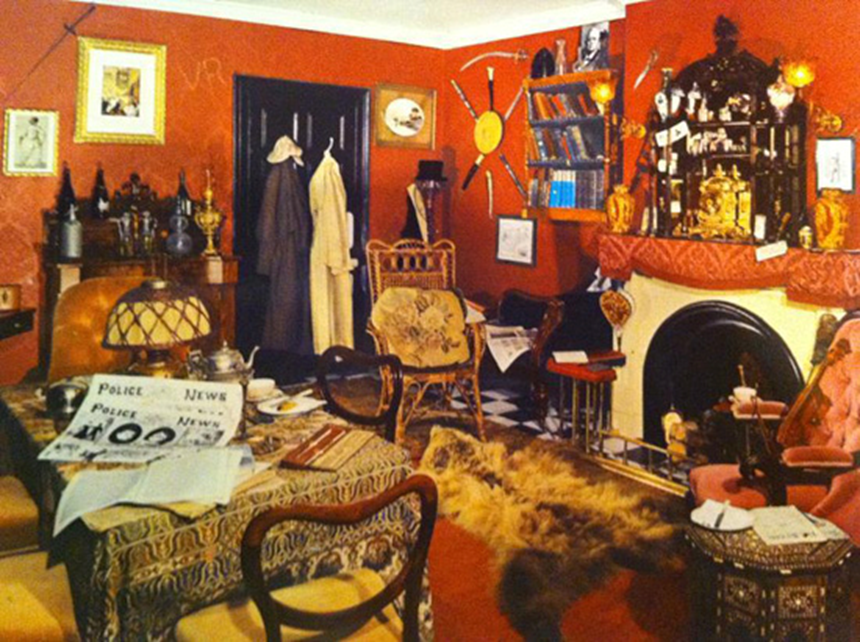
Sherlock Holmes Museum,
221B at the Sherlock Holmes Museum in Lucens, Switzerland (Image: The Reichenbach Irregulars)
Yet another replica of 221B exists in an older Sherlock Holmes museum in Switzerland, established in 1965 within a hotel in Lucens, frequently visited by Conan Doyle’s son. It is fascinating to observe that all these 221Bs have been deliberately arranged to suggest that Holmes and Watson had departed only moments before. It feels as though the sweet smoke of a pipe should still be drifting through the air. Surveying the strewn newspapers, scattered books, and half-empty teacups, one can easily envision the detective springing from his armchair, hot on the heels of a suspect or chasing a fresh lead. The carefully curated clutter whispers of an untold narrative, a new mystery left for the readers to imagine.
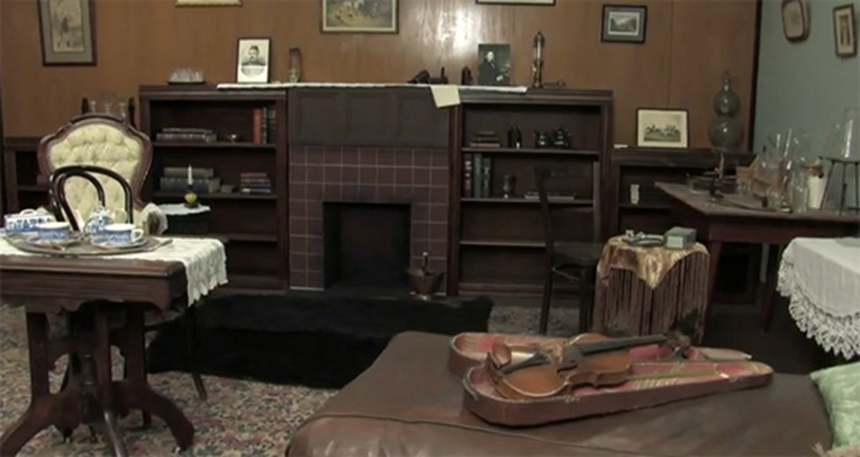
Room 221B, University of Minnesota.
Room 221B at the University of Minnesota (Image: Still from The University of Minnesota)
Across the ocean, yet another 221B awaits on the fourth floor of the Wilson Library at the University of Minnesota, which also proudly harbors the world’s largest collection of ephemera related to Sherlock Holmes and Arthur Conan Doyle. "The 221B Room," as it is affectionately known, was donated by the estate of avid Holmes collector Allen Mackler, who painstakingly recreated Holmes’s sitting room in his own home using authentic period artifacts. Mackler’s room was transported, piece by piece, to the University’s library.
221B Allen Mackler
Room 221B in Allen Mackler’s home (Image: University of Minnesota Libraries)
Undoubtedly, countless other partially reconstructed 221Bs reside in the homes of private collectors worldwide. Furthermore, innumerable sets have been erected for film and television, some of which adhered loyally to Conan Doyle’s text in their construction.
One might argue that the non-Baker Street flats are somewhat less authentic, given that they exist independently of their historical context. And yet, one could just as easily counter that there is no true historical context to speak of. After all, 221B Baker Street does not exist today, nor has it ever truly existed. These replicas are all, to varying degrees, authentic recreations. But is any single 221B intrinsically more authentic than the rest? How does one who is not a player in the Great Game measure the authenticity of a place that isn’t real? By geography? By how closely it mirrors the sparse descriptions and illustrations of the original text? Or perhaps by the purity of the Victorian antiques employed in the reproduction?
Be that as it may, revel in 221B Baker Street. Immerse yourself in its charm. Picture Sherlock and Watson reading and smoking their pipes, or lost in thought while listening to the resonant chords of a violin symphony. Allow yourself to be transported… to another era, and into a wondrous fictional reality.